September 9, 2026
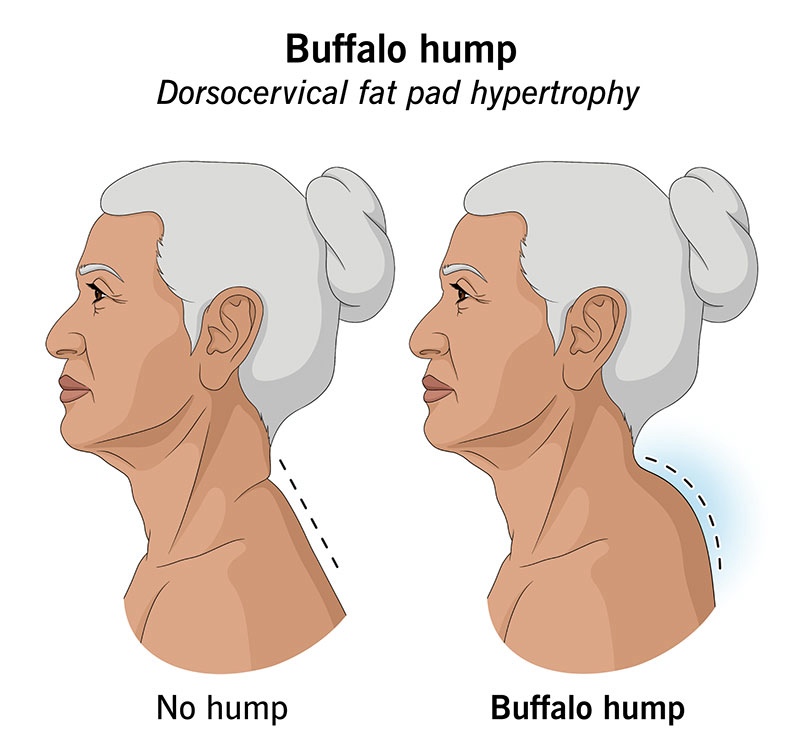
Have you noticed a rounded prominence developing at the base of your neck and between your shoulders?
Many people call this a “buffalo hump.” They may notice it when looking in the mirror, wearing certain clothing, or seeing themselves in photographs. Beyond appearance, some people also experience stiffness, aching, muscle tension, or discomfort around the neck and upper back.
But what exactly causes it?
The answer is not always as simple as “bad posture.”
A true dorsocervical fat pad, commonly referred to as a buffalo hump, can have several possible causes, including certain medications, hormonal conditions, and changes in body composition. On the other hand, a prominent area at the base of the neck can also be associated with changes in spinal and shoulder posture, particularly forward head posture and increased rounding of the upper back.
At my Toronto chiropractic practice, I frequently see patients who are concerned about this area and want to understand whether their posture is contributing to its appearance.
My approach is to look beyond the visible symptom and assess the underlying factors that may be keeping the head, neck, shoulders, and upper back in a forward position.
What Is a Buffalo Hump?
The term buffalo hump is commonly used to describe a noticeable fullness or rounded prominence in the area where the neck meets the upper back.
Medically, a dorsocervical fat pad refers specifically to an accumulation of fatty tissue in this region. It can occur for a number of reasons and should not automatically be attributed to posture.
That distinction is important.
If a patient has a new or pronounced fatty pad in this area, particularly if it develops without an obvious explanation, a medical assessment may be appropriate. Chiropractic care should not be used to assume that every dorsocervical fat pad is caused by spinal posture.
However, another common presentation is a postural prominence at the cervicothoracic junction. When the head sits forward, the upper back becomes more rounded, and the shoulders roll forward, the tissues around the base of the neck can appear much more prominent.
This is where corrective chiropractic care may have a role.
Why Do People Develop a Prominence at the Base of the Neck?
One of the most common postural patterns I see is forward head posture.
Ideally, the head is balanced relatively efficiently over the neck and torso. With forward head posture, the head moves forward in relation to the trunk. This often occurs alongside rounded shoulders and increased upper-back flexion.
Think about a typical day for someone working at a desk on Bay Street.
You sit down.
You lean toward the computer.
Your shoulders gradually round forward.
Your chin moves toward the screen.
You stay there for an hour.
Then another hour.
Then another.
Over time, this position can become less of something you consciously “do” and more of the posture your body automatically returns to.
Research has found an association between forward head posture and neck pain in adults, although the relationship is complex and posture should not be considered the sole cause of neck pain. PubMed: Forward Head Posture and Neck Pain Systematic Review
A more recent review also found that corrective exercise and certain manual therapy approaches can improve pain and disability in people with chronic neck pain and forward head posture. PubMed: Treatment of Chronic Neck Pain in Patients With Forward Head Posture
Why Patients Often Don’t Like the Appearance
The physical appearance of this area can be frustrating.
Some patients tell me:
This is not simply about vanity.
Your posture can influence how you feel about your body and how confidently you move through your day. When someone spends years sitting with the head forward and shoulders rounded, they may begin to feel that this posture has become their “normal.”
The goal of corrective care is not to promise that chiropractic treatment will eliminate a true fat pad. Instead, the goal is to identify whether modifiable spinal, muscular, movement, and ergonomic factors are contributing to the postural appearance and discomfort.
The Root Cause: Why Does the Body Keep Slouching?
At my chiropractic practice, I don’t want to simply tell a patient:
“Sit up straight.”
If that were enough, most people would solve their posture in a week.
The bigger question is:
Why does your body keep returning to the slouched position?
I commonly assess several factors.
1. Spinal Dysfunction and Restricted Movement
The spine is designed to move.
When multiple segments of the cervical and thoracic spine become restricted, a person may have difficulty moving comfortably through the ranges of motion needed for an upright posture.
From a NeuroStructural perspective, I am interested in how these movement restrictions may influence the way the body senses and responds to its position.
Proprioception—the body’s ability to sense position and movement—is an important component of postural control. Research examining forward head posture has reported changes in muscle activity and proprioception associated with altered head positioning. PubMed: Impact of Head Position on Body Functioning
This is one reason I don’t view posture as simply a matter of willpower.
Your nervous system is constantly receiving information about where your head, neck, shoulders, and spine are in space.
If movement and sensory input are altered, maintaining a better position may require more conscious effort.
It is important, however, not to overstate this mechanism: restricted spinal motion does not automatically mean that a nerve is being “pinched,” and evidence does not support claiming that every postural problem is caused by nerve pressure.
2. Weak or Poorly Coordinated Postural Muscles
Your muscles also have to support your posture.
The muscles surrounding the shoulder blades, upper back, neck, and trunk all contribute to maintaining an efficient position.
When the shoulders repeatedly fall forward, the muscles responsible for scapular positioning and upper-back support may not be doing their job effectively.
This can create a frustrating cycle:
Slouch → muscles fatigue → posture collapses → more slouching.
Corrective exercise is therefore an important part of many posture-focused programs. Research has found that therapeutic exercise can improve forward head posture and may also provide moderate improvements in neck pain. PubMed: Therapeutic Exercise for Forward Head Posture
At my Toronto clinic, the objective is not simply to “pull the shoulders back.” We want to help patients develop better control, strength, mobility, and awareness so an improved posture becomes easier to maintain.
3. Poor Workstation Ergonomics
Your environment matters.
You can receive excellent care and perform your exercises consistently, but if you spend eight hours every day positioned poorly at your workstation, your body is continually being exposed to the same stress.
For many Toronto professionals, this is one of the biggest contributors.
A monitor that is too low.
A laptop sitting directly on the desk.
A chair that doesn’t support you properly.
A mouse positioned too far away.
Hours of uninterrupted sitting.
None of these individually guarantees that someone will develop a postural problem. But together, they can make maintaining an efficient position much more difficult.
How Corrective Chiropractic Care Approaches the Problem
At Dr. Mateusz Krekora Chiropractic Clinic, my NeuroStructural Corrective Process focuses on identifying the factors that may be contributing to poor posture rather than simply chasing the appearance of the bump.
An assessment may consider:
Based on the findings, care may incorporate chiropractic adjustments, posture correction strategies, corrective exercises, mobility work, and ergonomic recommendations.
The goal is to create an environment where your body has a better opportunity to maintain an upright, comfortable position.
This is particularly important because posture correction is rarely a single-session solution. It involves changing the relationship between your spine, muscles, nervous system, movement habits, and environment.
Local Tips for Better Posture in Toronto
If you work at a desk in downtown Toronto, start by looking at your workstation.
Raise your screen. Your eyes should be directed toward the upper portion of the monitor rather than constantly looking down.
Bring the keyboard and mouse closer. You shouldn’t need to reach forward for hours at a time.
Change positions regularly. Even a good sitting posture becomes problematic if you never move.
Strengthen your upper back. Exercises that improve scapular control and postural endurance can complement mobility work.
Pay attention to your phone. Spending long periods with your head dropped toward your phone can reinforce the same forward-head position.
And don’t forget movement outside the office. Walking, cycling, and other activities can provide valuable opportunities to move your spine and body in ways that sitting at a desk does not.
Can Corrective Chiropractic Get Rid of a Buffalo Hump?
This is where an honest answer matters.
If what you have is a true dorsocervical fat pad, chiropractic adjustments should not be presented as a treatment that simply removes the underlying fat.
However, if the appearance is significantly influenced by forward head posture, upper-back rounding, restricted spinal movement, muscular weakness, or poor movement habits, addressing those factors may improve posture and potentially change how the area looks and feels.
And if the prominence is new, rapidly changing, unusually pronounced, or accompanied by other unexplained symptoms, it is important to speak with your physician or another appropriate healthcare professional to determine whether there is an underlying medical cause.
Conclusion: Look Beyond the Bump
A prominent area at the base of your neck can be frustrating, especially when you don’t recognize the posture you see in the mirror.
But the solution isn’t always to simply force your shoulders backward and hope for the best.
At my Toronto chiropractic practice, I often see patients improve when we stop focusing exclusively on the visible symptom and start investigating why their body has adopted that position in the first place.
Spinal movement, postural muscle function, proprioception, daily habits, and workstation ergonomics can all be relevant pieces of the puzzle.
That’s the philosophy behind NeuroStructural Corrective Care: understand the structure and function, identify the contributing factors, and build a plan that helps you move and hold yourself better over time.
If you’re concerned about a “buffalo hump,” forward head posture, rounded shoulders, or a growing prominence at the base of your neck, an individual assessment can help determine whether your posture may be contributing.
Ready to feel 25 again?
Book Your Free Case Review and let’s take a closer look at what’s happening with your posture and spine.
This article is for informational purposes only and should not be taken as medical advice. Please consult a licensed chiropractor before starting any treatment.

.png)
