October 7, 2026
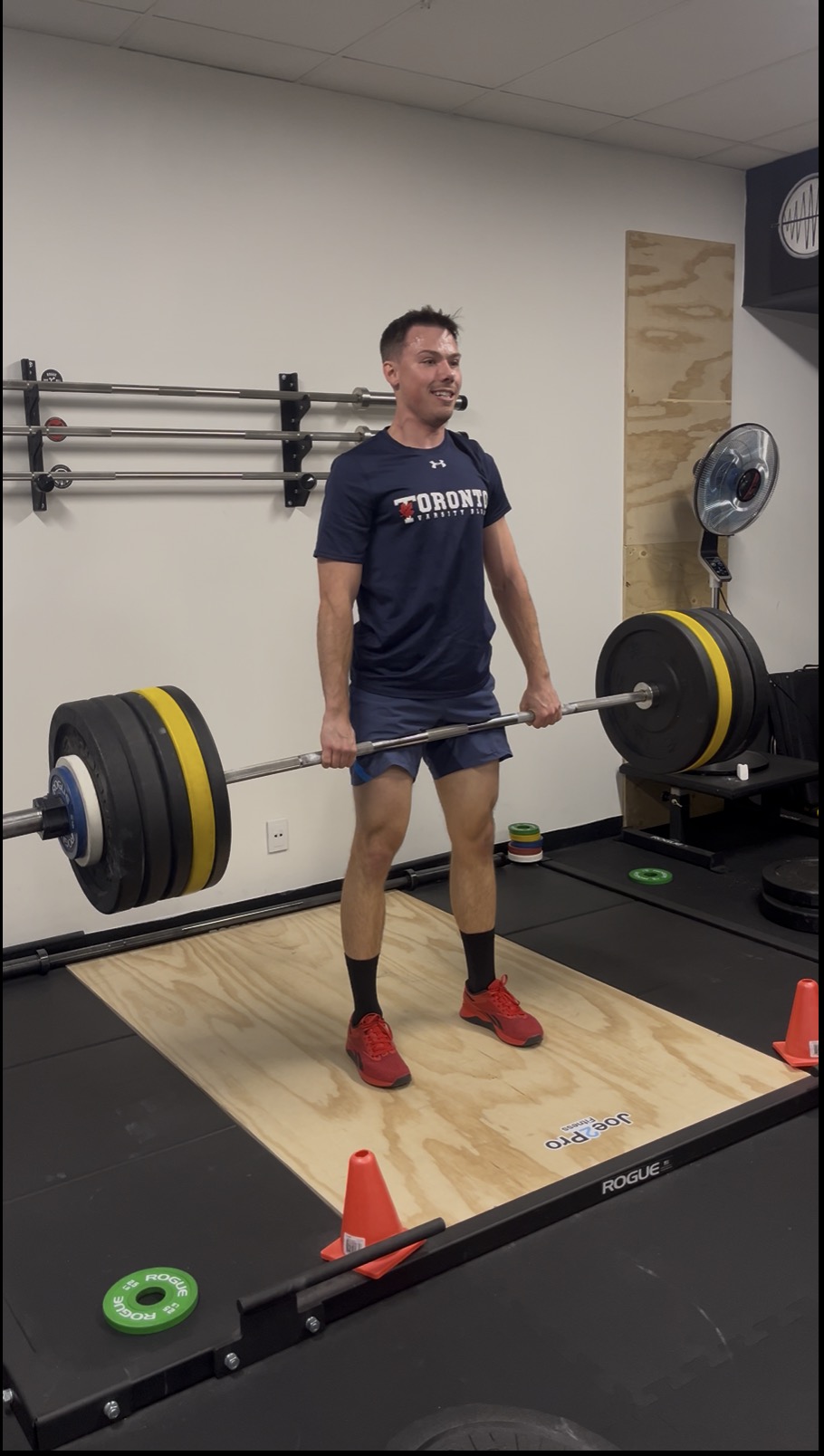
Few exercises have the reputation of the deadlift.
Some people love it. Others avoid it completely because they have heard that deadlifting is “bad for your back.” And then there are people who have tried it, only to feel the exercise almost entirely in their lower back rather than their legs and glutes.
As a Toronto chiropractor who works with active people, I understand why the deadlift can feel intimidating. But I also believe it is an exercise worth learning properly.
The deadlift is a compound, full-body movement that trains you to produce force through your hips and legs while controlling your trunk. Research describes the deadlift as a multi-joint exercise involving the lower extremities and spinal erectors, making it much more than simply a “back exercise.” (PubMed)
The goal isn’t to convince everyone that they must deadlift. Instead, it is to show you how I approach deadlifting safely and progressively with myself and with appropriate patients at my Toronto clinic.
Why Do So Many People Avoid Deadlifts?
There are two common reasons.
First, they are afraid of hurting their back.
This concern isn’t completely unreasonable. A heavy deadlift places substantial demands on the muscles and structures around the lumbar spine. The Ontario Chiropractic Association also emphasizes that deadlifts can be excellent exercises for building a strong back, while poor technique can increase the likelihood of back injury. Their guidance includes maintaining a neutral lower back and keeping the load close to the body. (OCA)
But there is an important distinction between an exercise being demanding and an exercise automatically being dangerous.
Your body needs exposure to progressively greater demands if you want to become stronger. The mistake is often jumping into a movement with more weight than your current strength and movement control can handle.
Second, people can’t feel the deadlift where they expect to.
If every repetition feels like a low-back exercise, you may not yet have mastered the hip hinge or developed the strength and coordination needed to distribute the workload effectively between your hips, legs and trunk.
A well-executed deadlift should involve the posterior chain—including the glutes and hamstrings—while the spinal erectors work to stabilize the trunk.
That makes the deadlift particularly valuable.
The Deadlift Is a Powerful Leg Exercise
Despite its reputation as a “back exercise,” the deadlift can provide a significant training stimulus to the hips and lower extremities.
Biomechanical research comparing conventional, sumo and hex-bar deadlifts demonstrates that different deadlift variations can shift the demands placed on the hip and knee extensors. (PubMed)
This is one reason I like the deadlift as a functional strength exercise.
Think about what happens in everyday life.
You pick up a heavy box.
You lift a suitcase.
You move furniture.
You pick something up from the floor.
You need to generate force through your legs and hips while keeping your trunk controlled.
The deadlift essentially gives you a structured way to train that pattern.
It also has an advantage that many machine-based exercises don’t: your entire body has to coordinate to accomplish the task.
Your feet interact with the floor. Your legs produce force. Your hips extend. Your trunk stabilizes. Your grip works. Your upper back maintains position.
That’s functional strength.
Deadlift Tip #1: Build Your Lumbar Extensor Endurance First
One of my first considerations with a new deadlifter is whether the muscles responsible for controlling the trunk have the endurance required for the exercise.
If your lumbar erectors fatigue quickly, you may struggle to maintain a consistent trunk position as your repetitions accumulate.
One exercise I commonly use as a preparation tool is the back extension isometric hold, commonly associated with the Biering-Sørensen test or Sorensen hold.
The Sorensen test has been widely studied as a measure of back-extensor endurance. Research shows that the exercise also involves the hip extensors, meaning it isn’t an isolated test of the lumbar muscles—but it is a useful way of developing and assessing posterior-chain endurance. (PubMed)
Start with an appropriate variation and duration rather than trying to hold the position for as long as possible.
The objective isn’t to exhaust your back.
It is to gradually teach your body to tolerate and control sustained trunk loading.
This is particularly relevant for people who describe their lower back as feeling “tight” during exercise. Tightness doesn’t automatically mean that a muscle is weak, but sometimes improving strength and endurance can change how the movement feels.
The Canadian Chiropractic Association also emphasizes using the legs and arms rather than relying exclusively on the back when lifting loads. (Canadian Chiropractic Association (CCA))
Deadlift Tip #2: Master the Hip Hinge
Before loading a barbell, learn how to hinge.
This may sound simple, but it is one of the most important pieces of the puzzle.
A hip hinge means that your hips move backward while your trunk remains controlled, allowing you to load the hips and posterior chain without simply bending through your lower back.
One of my favourite ways to teach this is with a dowel hip hinge.
Place a dowel along your back so that it maintains contact with three points:
Then practice pushing your hips backward while maintaining those contact points.
You aren’t trying to squat down.
You are learning to fold at the hips.
This gives your nervous system a simple reference for what controlled spinal positioning feels like while the hips move.
Research examining lifting mechanics has specifically highlighted the importance of hip-hinge skill and trunk positioning when performing lifting exercises. (PubMed)
Once the hip hinge becomes natural, transferring that movement pattern to a deadlift becomes much easier.
Deadlift Tip #3: Don’t Skip the Single-Leg RDL
The single-leg Romanian deadlift (single-leg RDL) is one of my favourite exercises for preparing someone for a conventional deadlift.
Think of it as a miniature deadlift performed on one leg.
You hinge through the hip while the other leg extends behind you, requiring the working side to control the pelvis, hip and trunk.
Why do I like it?
Because bilateral exercises can sometimes hide differences between your left and right sides.
If your right leg is stronger or more coordinated than your left, you may unconsciously shift more work onto the stronger side during a conventional deadlift.
Research has demonstrated that asymmetrical weight distribution can occur during deadlifting, which is one reason unilateral exercises can be useful when assessing and developing movement control. (PubMed)
Research on single-leg RDLs has also demonstrated substantial involvement of the gluteus maximus, hamstrings and trunk stabilizers, making the movement useful for posterior-chain training. (PubMed)
I don’t view the single-leg RDL as an automatic “injury prevention” exercise. Nothing about one exercise guarantees that you won’t get injured.
Instead, I view it as a screening and strengthening opportunity.
Can you control your pelvis?
Can you hinge without rotating?
Does one side feel substantially different?
Can you maintain balance while producing force through one hip?
Those are valuable questions.
Deadlift Tip #4: Keep the Bar Close
Once you progress to the actual deadlift, pay attention to the path of the bar.
Generally, you want the weight to remain close to your body rather than drifting forward.
Why?
Because moving the load farther away changes the mechanical demands on your body and can make the lift unnecessarily difficult.
The Ontario Chiropractic Association specifically recommends keeping the bar close to the body and maintaining a neutral lower back when deadlifting. (OCA)
Think:
Bar close.
Brace your trunk.
Push through the floor.
Drive the hips through.
Rather than:
Pull with your lower back.
Deadlift Tip #5: Start Lighter Than Your Ego Wants
This may be the most important tip of all.
You don’t need to prove anything with your first deadlift.
Start with a load that allows you to develop consistent technique.
Then gradually increase the challenge.
Recent research examining deadlift intensity found that very high loads can alter lifting mechanics and increase erector-spinae activity. The researchers suggested that loads above 90% of 3RM may not be necessary when the goal is developing hip-extensor strength. (PubMed)
In other words, heavier isn’t automatically better.
If your goal is building strong legs, glutes and a resilient posterior chain, you have many productive loading options before you need to test your maximum strength.
What If You Still Feel the Deadlift Mostly in Your Back?
This is where an individualized assessment can be helpful.
If you have worked on your lumbar extensor endurance, learned the hip hinge, practiced unilateral RDLs and progressed gradually—but still cannot perform a deadlift comfortably or effectively—there may be another factor worth investigating.
At my Toronto clinic, I may look at things such as:
The goal isn’t to find something “wrong” with everyone.
Sometimes the solution is simply better coaching, a different deadlift variation or a more appropriate starting load.
But when persistent movement limitations or pain are present, a professional assessment can help determine what is contributing to the problem.
The Ontario Chiropractic Association notes that chiropractors can evaluate strength, flexibility and spine, muscle and joint function, and develop exercise programs appropriate to an individual’s needs. (OCA)
Deadlifting in Toronto: Build Strength for Real Life
Living in Toronto often means spending hours at a desk, commuting, cycling, training in the gym or simply trying to stay active despite a busy schedule.
Whether you’re working on Bay Street, cycling the Don Valley trails or training at your local gym, strength matters.
You don’t need to become a competitive powerlifter.
You need a body that can tolerate the demands of the activities you enjoy.
That’s why I like the deadlift when it is appropriately prescribed and progressed.
It trains more than a single muscle.
It teaches you how to coordinate your feet, legs, hips and trunk to produce force.
And perhaps most importantly, it can help you become more confident with lifting.
Conclusion: Earn Your Deadlift
The deadlift doesn’t need to be an exercise you fear.
But you also don’t need to rush into heavy barbell deadlifts just because everyone else at the gym is doing them.
Build the foundation first:
1. Strengthen your lumbar and posterior-chain endurance.
2. Master the hip hinge.
3. Practice the single-leg RDL to develop unilateral control.
4. Start with manageable loads.
5. Keep the bar close and focus on driving through the legs and hips.
6. Progress gradually rather than chasing maximum weight.
And if you’ve tried all of this but still can’t perform a deadlift comfortably, an individualized chiropractic assessment may be worthwhile.
At Dr. Mateusz Krekora Chiropractic Clinic, our NeuroStructural approach looks beyond the immediate symptom and considers how the spine, joints and surrounding musculature are functioning together.
You don’t have to give up on strength training because your back doesn’t feel right.
Sometimes, you simply need to find out why.
Ready to feel strong and live to the fullest? Book Your Free Case Review and let’s start working toward feeling 25 again.
This article is for informational purposes only and should not be taken as medical advice. Please consult a licensed chiropractor before starting any treatment.

.png)
