November 2, 2026
Could Your Feet Be Contributing to Your Low Back Pain?
If you suffer from low back pain, you probably think about your spine, muscles, or posture as the source of the problem. But have you ever considered the role your feet might play?
As a chiropractor in Downtown Toronto, I see many patients experiencing low back pain who may also benefit from a closer look at their foot mechanics. Whether you’re spending long hours at a desk on Bay Street, walking through the Financial District, or enjoying an active afternoon along Toronto’s waterfront, the way your feet interact with the ground can influence how your body moves.
Your feet provide the foundation for standing, walking, and running. When foot mechanics affect the way you distribute your weight or move through your lower body, they may contribute to additional demands on the ankles, knees, hips, and lower back.
This is where custom orthotics may play a valuable role in a comprehensive approach to low back pain management.
Custom orthotics are specially designed shoe inserts intended to support your feet and address individual biomechanical needs. When appropriately prescribed and fitted, they may help improve comfort, support foot function, and complement other treatments aimed at improving mobility and managing pain.
At Dr. Mateusz Krekora Chiropractic Clinic, I take a broader view of musculoskeletal health. Rather than looking exclusively at where you feel pain, I consider how different parts of your body work together.
Let’s explore the common benefits of custom orthotics, how they may help people with low back pain, and when they might be worth considering.
What Are Custom Orthotics?
Custom orthotics are individually designed shoe inserts created to accommodate your feet and address specific biomechanical needs.
Unlike generic insoles purchased at a pharmacy, custom-made orthotics are developed following an assessment of your feet, movement, and relevant symptoms. Depending on your needs, they may be designed to provide arch support, influence foot motion, redistribute pressure, or improve comfort during standing and walking.
The goal isn’t simply to make your shoes feel softer. It’s to provide support appropriate to your individual foot structure and functional requirements.
Custom orthotics may be considered for people experiencing issues such as:
The suitability of orthotics depends on the individual and the problem being addressed. Custom devices are not automatically better than over-the-counter insoles for everyone.
Research published in the Cochrane Database of Systematic Reviews highlights that the effectiveness of custom orthotics varies according to the foot condition being treated.
For this reason, a proper assessment is an important first step in determining whether custom orthotics are appropriate for you.
How Can Custom Orthotics Help with Low Back Pain?
To understand the potential relationship between your feet and lower back, it helps to look at how your body moves as a connected system.
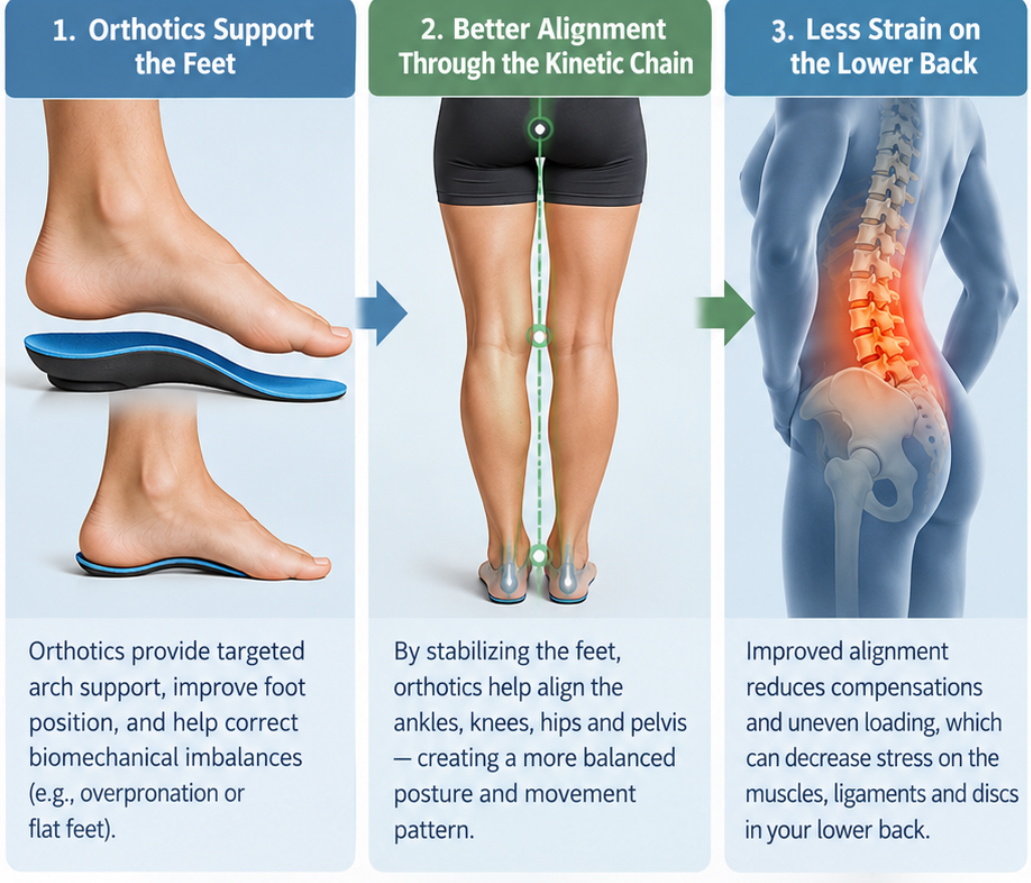
When you stand or walk, forces travel from the ground through your feet and ankles, into your knees and hips, and through your pelvis and spine.
Your body constantly adjusts to these forces to maintain balance and coordinate movement.
Changes in foot mechanics can influence lower-limb movement and loading patterns. In some people, these changes may contribute to discomfort in other areas, including the lower back.
However, not all low back pain originates in the feet, and foot mechanics are only one of many factors that may influence symptoms.
Here are several ways custom orthotics may help selected individuals.
1. Supporting Foot Mechanics and Lower-Limb Alignment
Your feet influence how your lower body interacts with the ground.
For example, some people have feet that roll inward excessively during walking, a movement commonly associated with increased pronation. Pronation itself is a normal part of walking, but its degree, timing, and relationship to other movements can vary between individuals.
In some cases, foot mechanics may influence the movement of the lower legs and thighs, potentially affecting how the hips and pelvis move during standing or walking.
Custom orthotics can be designed to influence foot motion and provide support where appropriate.
For a person whose low back symptoms are associated with these movement patterns, addressing foot mechanics may help reduce unnecessary strain during everyday activities.
It’s important to understand that orthotics do not directly realign the spine or guarantee better pelvic alignment. Their potential benefit depends on whether the specific foot mechanics being addressed are relevant to that person’s symptoms.
2. Helping Distribute Pressure More Comfortably
Your feet absorb and transmit forces every time you take a step.
If pressure is concentrated in areas of the feet that are sensitive or poorly supported, walking and standing may become uncomfortable. This can sometimes lead to changes in how you distribute your weight or move.
Custom orthotics may help redistribute pressure beneath the feet and improve support during weight-bearing activities.
For someone who spends most of the day standing at work, walking between meetings, or commuting on foot through Downtown Toronto, improving foot comfort may make daily movement easier.
While this does not necessarily resolve the underlying cause of low back pain, improving comfort and movement tolerance can be a useful part of a broader management strategy.
3. Supporting More Comfortable Walking
Walking is one of the simplest ways to remain active, but low back pain can make it difficult to maintain a comfortable stride.
When walking hurts, people may unconsciously shorten their steps, shift their weight, or avoid loading one side of the body as much as the other.
If foot discomfort or certain foot mechanics contribute to these changes, appropriately selected orthotics may help make walking more comfortable.
The potential benefit is particularly relevant for people who experience symptoms during prolonged walking or standing.
For example, someone who walks extensively between Union Station, their office, and nearby restaurants may find that foot discomfort makes it harder to stay active throughout the day.
By addressing an identified foot-related issue, orthotics may help support a more comfortable walking pattern.
Of course, persistent changes in gait or pain on one side should be assessed rather than automatically attributed to the feet.
4. Potentially Reducing Low Back Pain and Disability
Can orthotics directly reduce low back pain?
The research is encouraging in some areas, but the evidence needs to be interpreted carefully.
A 2020 systematic review and meta-analysis published in Research in Sports Medicine examined studies investigating shoes and insoles for low back pain. The authors reported moderate-quality evidence suggesting that custom-made orthotics could improve pain and disability outcomes in people with chronic low back pain compared with no orthotic intervention.
More recent research has also explored whether particular groups of patients are more likely to benefit.
A 2024 systematic review and meta-analysis examined physical interventions for people with chronic low back pain and pronated feet. Its findings suggested improvements in pain and disability among the studied participants, although the evidence came from a relatively small number of studies.
These findings are promising, but they do not mean that custom orthotics will help everyone with back pain.
Research differs in the types of orthotics used, the participants studied, and the duration of treatment. Some studies have also reported conflicting results.
The practical takeaway is that custom orthotics may be a useful addition to low back pain care for selected individuals, particularly when a relevant foot-related biomechanical issue is identified. They should not be presented as a guaranteed solution or a replacement for appropriate assessment and rehabilitation.
5. Complementing a Broader Chiropractic Care Plan
Low back pain can have many contributing factors, including physical activity levels, prolonged sitting, muscle function, movement habits, and individual health circumstances.
This is why I believe it’s important to assess the whole person rather than focus on a single symptom.
At Dr. Mateusz Krekora Chiropractic Clinic, custom orthotics may be considered alongside other appropriate approaches, depending on the patient’s assessment and goals.
These may include chiropractic care, mobility exercises, strengthening, posture education, and practical advice for managing the demands of work and daily activities.
For example, an office worker with low back discomfort may benefit from a combination of movement breaks, a more comfortable workstation, appropriate exercise, and orthotics if a relevant foot-related concern is identified.
The goal is to develop a plan that addresses the factors contributing to the person’s symptoms rather than assuming one treatment will solve everything.
What Are the General Benefits of Custom Orthotics?
Even when low back pain is not the primary concern, custom orthotics may provide other benefits when they are appropriately selected.
Improved Foot Support
Orthotics can provide support tailored to the shape and functional needs of your feet. This may be helpful for people whose symptoms are aggravated by prolonged standing or walking.
Better Pressure Distribution
Depending on their design, orthotics can help redistribute pressure across the foot. This may improve comfort during weight-bearing activities.
Support During Daily Activities
Whether you’re walking to work, standing throughout a busy shift, or exercising, appropriate orthotics may make certain activities more comfortable.
Assistance With Specific Foot Mechanics
For people with particular foot mechanics that contribute to symptoms, orthotics may help guide or accommodate movement.
Individualized Care
Custom-made orthotics are developed around an individual’s assessment rather than relying on a one-size-fits-all design.
However, custom orthotics are not a universal solution for foot, knee, hip, or back pain. Their benefits depend on the person’s condition, the device’s design, and how well the treatment fits their needs.
Are Custom Orthotics Right for Your Low Back Pain?
If you’re experiencing low back pain, the first step is determining what may be contributing to your symptoms.
During an assessment, several factors may be relevant, including:
This information can help determine whether orthotics are worth considering or whether another approach may be more appropriate.
It’s also important to recognize that low back pain sometimes requires medical evaluation. Seek urgent medical attention if back pain occurs with new loss of bladder or bowel control, numbness around the groin or saddle area, or rapidly progressing leg weakness.
Orthotics should never delay assessment of concerning symptoms.
Local Tips for Managing Low Back Pain in Toronto
Custom orthotics may be one part of your plan, but your everyday habits matter too.
Here are several practical suggestions for staying comfortable while living and working in Toronto.
1. Choose appropriate footwear. Look for shoes that fit comfortably and suit your daily activities. If you’re considering orthotics, bring your usual footwear to your assessment so compatibility can be considered.
2. Break up prolonged sitting. If you work at a desk on Bay Street or in the Financial District, take regular movement breaks. Stand up, walk briefly, and change positions throughout the day.
3. Build walking into your routine. If tolerated, regular walks around the waterfront or through nearby neighbourhoods can help you maintain activity. Start at a comfortable level and increase gradually.
4. Prioritize strength and mobility. Appropriate exercise can help support physical function and build tolerance for everyday demands. A healthcare professional can help you choose exercises suited to your needs.
5. Avoid relying on one treatment alone. Orthotics may help address certain foot-related factors, but managing low back pain often requires a broader approach tailored to your symptoms and goals.
Consistency with appropriate movement, footwear, and an individualized care plan can be more useful than searching for one device that promises to fix everything.
Conclusion: Explore Custom Orthotics With Dr. Mateusz Krekora
Your feet and lower back work together every day. Although foot mechanics are not the cause of every case of low back pain, they may be a contributing factor for some individuals.
Custom orthotics can provide individualized foot support, help redistribute pressure, and potentially improve pain and function in selected people with low back pain. Research suggests there may be benefits, but results vary, and orthotics work best when there is a clear reason to use them.
As a chiropractor in Downtown Toronto, I believe effective care begins with understanding your individual needs. At Dr. Mateusz Krekora Chiropractic Clinic, we can assess whether custom orthotics may be an appropriate part of your plan and discuss how they could complement other strategies for improving comfort and mobility.
Interested in Custom-Made Orthotics?
If you’re experiencing low back pain, foot discomfort, or difficulty staying comfortable while standing and walking, I invite you to learn whether custom orthotics may be right for you.
You can have your custom-made orthotics made with Dr. Mateusz Krekora at our Downtown Toronto chiropractic clinic.
An important note about insurance: Many extended health insurance plans require a prescription from a medical doctor before they will reimburse custom orthotics. Requirements vary by insurer and individual plan, so please obtain the prescription beforehand and confirm your coverage before proceeding.
Ready to take the next step toward moving more comfortably?
Book Your Free Case Review and let’s discuss your concerns and potential care options.
Feel strong, live to the fullest.
This article is for informational purposes only and should not be taken as medical advice. Please consult a licensed chiropractor before starting any treatment.


