January 2, 2026
Introduction
If you spend long hours at a desk in Toronto’s Financial District, cycle the Don Valley Trail, or commute daily on the TTC with rounded shoulders and a forward head posture, you may be placing chronic stress on your neck, shoulders, and upper chest. Over time, these stresses can contribute to a condition known as Thoracic Outlet Syndrome (TOS).
At Dr. Mateusz Krekora Chiropractic Clinic, I often see patients who have persistent neck pain, arm numbness/heaviness, shoulder tightness, or weakness that hasn’t resolved with rest alone. Many are surprised to learn that these symptoms can be linked to poor spinal alignment and posture affecting the thoracic outlet.
Corrective chiropractic care focuses on reducing pressure on nerves and blood vessels by restoring spinal health and posture, addressing the root causes rather than just managing symptoms.
Understanding Thoracic Outlet Syndrome
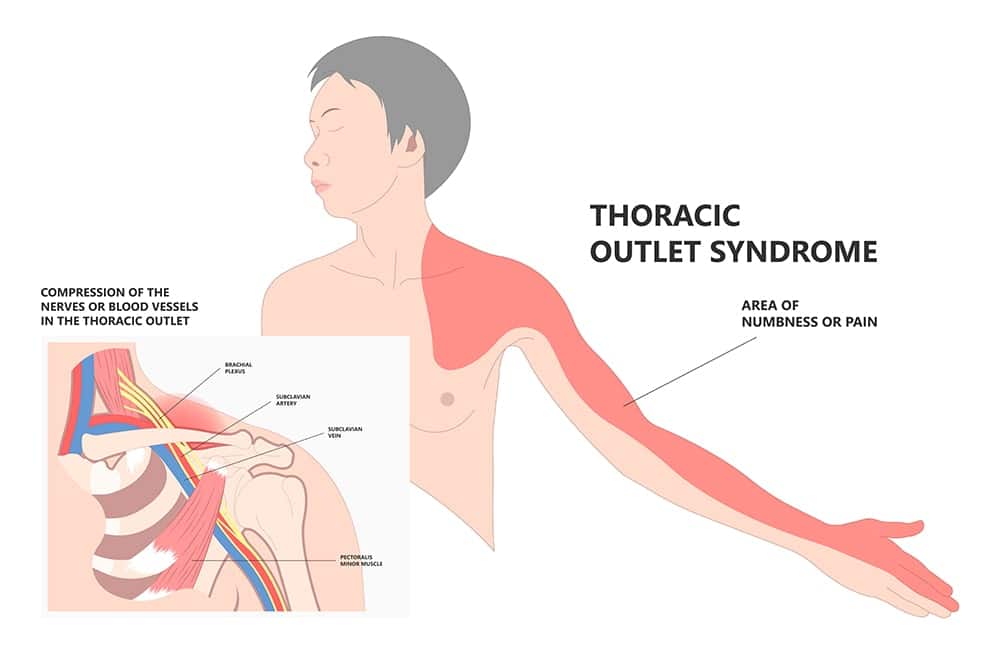
Thoracic Outlet Syndrome refers to a group of conditions that occur when nerves or blood vessels are compressed as they pass through the thoracic outlet—the narrow space between the collarbone (clavicle), first rib, and surrounding muscles.
According to the Canadian Chiropractic Association, TOS is often related to postural strain, repetitive activities, and spinal or rib dysfunction that alters this already tight anatomical corridor (Canadian Chiropractic Association).
Common Types of Thoracic Outlet Syndrome
While there are three recognized forms of TOS, the two most commonly discussed in conservative care are:
1. Neurogenic (Nerve) Thoracic Outlet Syndrome
This is the most prevalent form. It involves compression of the brachial plexus, the network of nerves supplying the shoulder, arm, and hand. Symptoms may include:
Peer-reviewed literature notes that nerve compression is frequently associated with postural changes and muscular imbalance around the cervical and thoracic spine (PubMed).
2. Arterial Thoracic Outlet Syndrome
Arterial TOS is less common but more serious, involving compression of the subclavian artery. Symptoms may include:
Research suggests that bony or postural changes, such as elevated ribs or altered clavicle positioning, can contribute to arterial compression (PubMed).
While venous TOS also exists, it is less commonly addressed through conservative care and often requires medical co-management.
Why Posture and Spinal Health Matter in TOS
The thoracic outlet is highly sensitive to changes in posture. Forward head posture, rounded shoulders, and an immobile upper thoracic spine can all reduce the available space for nerves and blood vessels.
The Government of Canada emphasizes that prolonged poor posture—especially in seated work—can lead to musculoskeletal strain and nerve irritation (Government of Canada – Ergonomics).
From a clinical perspective, poor posture often leads to:
All of these factors can contribute to thoracic outlet compression.
Expert Insight with Dr. Krekora: A Corrective Perspective on TOS
As a Toronto-based chiropractor specializing in NeuroStructural Corrective Care, I view Thoracic Outlet Syndrome not as an isolated shoulder or arm problem, but as a global spinal and postural issue.
At my clinic, I often see that patients with TOS-like symptoms have:
Corrective chiropractic care focuses on identifying why these compensations developed in the first place and how they are affecting nerve and vascular pathways.
How Corrective Chiropractic Care Helps Reduce Compression
1. Improving Spinal Alignment
Corrective chiropractic adjustments aim to restore proper alignment and motion in the cervical and thoracic spine. Research shows that improved spinal mobility can reduce mechanical stress on surrounding soft tissues (Ontario Chiropractic Association).
2. Reducing Nerve Pressure
When spinal joints move properly, there is less irritation to the nervous system. Decreasing nerve pressure may help reduce symptoms such as numbness, tingling, and weakness commonly associated with neurogenic TOS.
3. Optimizing Rib and Clavicle Mechanics
The first rib plays a key role in thoracic outlet space. Restricted rib movement can narrow this passageway. Gentle corrective techniques help normalize rib motion and reduce tension in surrounding muscles.
4. Postural Correction and Stability
Corrective care goes beyond adjustments. Postural retraining helps patients maintain improvements long-term. This is especially important for Toronto professionals who spend hours at a computer or on mobile devices.
Current evidence suggests that multimodal conservative care—including spinal manipulation and posture-focused rehabilitation—may improve functional outcomes in TOS management (PubMed).
Local Tips for Managing TOS in Toronto
Living and working in Toronto presents unique postural challenges. Here are practical strategies I often recommend alongside corrective care:
These habits support spinal health and reduce recurring stress on the thoracic outlet.
Conclusion
Thoracic Outlet Syndrome—whether nerve-related or arterial—often begins with chronic pressure caused by poor posture and spinal imbalance. Corrective chiropractic care focuses on improving spinal health, restoring proper motion, and reducing stress on vital neurological and vascular structures.
At Dr. Mateusz Krekora Chiropractic Clinic, our NeuroStructural approach is designed to address the root causes of dysfunction, not just the symptoms.
If you’re dealing with persistent neck, shoulder, or arm discomfort, I invite you to take the next step.
👉 Book Your Free Case Review and start moving toward a stronger, more resilient body—so you can feel like you’re 25 again.
This article is for informational purposes only and should not be taken as medical advice. Please consult a licensed chiropractor before starting any treatment.

.png)
