Introduction
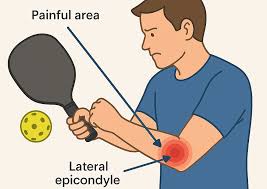
Pickleball has exploded across Toronto—from the courts at Ramsden Park to community gyms throughout the city. But with its rise comes something I’m seeing more often in my clinic: pickleball-related tennis elbow.
If you’ve felt a sharp or nagging pain around the outside of your elbow after a game, you’re not alone. This condition, known clinically as lateral epicondylagia, is becoming increasingly common among new and experienced players.
At Dr. Mateusz Krekora Chiropractic Clinic, I help Toronto patients address tennis elbow by correcting not just the irritated tissues—but the underlying structural and movement patterns causing the overload in the first place.
The Problem: Why Pickleball Causes Tennis Elbow
Unlike tennis, pickleball uses a smaller court and shorter rallies—but surprisingly more strain can occur at the elbow. Here’s why:
1. Stiff Paddle, More Vibration
Pickleball paddles don’t absorb impact as well as tennis racquets. This means the force travels directly into the forearm extensor muscles and the tendon attachment at the elbow.
2. Repetitive Wrist-Dominant Movements
Beginners often rely on the wrist for control rather than engaging the shoulder or torso. Repeated wrist extension is the main mechanical driver of tennis elbow.
3. Overuse + Underprepared Muscles
According to the Canadian Chiropractic Association, repetitive strain injuries become more common when load exceeds tissue capacity, especially in recreational athletes CCA – Repetitive Strain Injuries.
4. Poor Posture From Desk Work
I see this every week in downtown Toronto: long hours at a laptop weaken the mid-back and shoulder stabilizers. When those muscles aren’t doing their job on the court, the elbow takes the hit.
When these factors accumulate, the tendon becomes overloaded, inflamed, and painful—especially during gripping, backhand shots, or lifting objects.
Expert Insight (Dr. Mateusz’s Perspective)
At my chiropractic clinic in downtown Toronto, I’ve treated many players ranging from recreational weekend pickleballers to competitive athletes. One pattern is crystal clear:
The elbow is rarely the true root cause.
Most of my patients present with:
These compensations force the smaller elbow muscles to absorb loads they aren’t designed for.
Research published in The Journal of Orthopaedic & Sports Physical Therapy notes that addressing shoulder and upper-back function significantly improves outcomes in lateral elbow pain
JOSPT – Lateral Elbow Tendinopathy.
That’s why symptom-only treatments often fall short. Ice, elbow/forearm braces, and rest can calm things down temporarily—but without correcting mechanics, the pain returns as soon as you get back on the court.
How NeuroStructural Corrective Chiropractic Solves the Issue
My NeuroStructural Corrective Process focuses on the whole kinetic chain—not just the elbow.
1. Structural Assessment of Neck, Shoulder, and Thoracic Spine
We begin with a detailed analysis of:
This is essential because nerve tension from the neck or shoulder can make the elbow more sensitive, as outlined by the Ontario Chiropractic Association OCA – Nerve and Joint Function.
2. Chiropractic Adjustments to Improve Mobility
Gentle, precise adjustments help restore movement in:
Improved mobility = better shock absorption = less elbow strain.
3. NeuroFunctional Acupuncture for Pain Relief and Muscle Activation
This technique improves blood flow, reduces irritation, and reactivates inhibited muscles.
Studies on acupuncture for tendon pain in PubMed show meaningful reductions in pain intensity PubMed – Acupuncture for Tendinopathy.
4. Corrective Strength and Stability Training
Instead of generic exercises, I create a personalized plan focused on:
These corrections stop the cycle of re-irritation and time away from the pickleball court.
5. Court-Specific Biomechanics Coaching
Small changes in swing technique can drastically reduce elbow load.
I often coach patients on:
Correcting these habits protects you long-term.
Local Tips for Recovery and Maintenance (Toronto-Specific)
Whether you play at Ramsden Park, Riverdale Park, or indoor courts across the city, these tips help you avoid flare-ups:
✔ Warm Up Your Shoulders at the Court
Add arm circles, band pull-aparts, or light rotation movements before hitting.
✔ Strengthen Between Games
Use a light resistance band during work breaks—especially if you sit all day on Bay Street.
✔ Alternate Courts to Avoid Overuse
If you play often at Withrow Park or Greenwood, mix in recovery days.
✔ Check Your Paddle
Choose a paddle designed to reduce vibration—this small change makes a big difference.
✔ Don’t Push Through Pain
Early intervention is key. Tendon irritation is easier to correct when treated quickly.
Conclusion
Pickleball is an incredible sport—fun, social, accessible, and growing fast across Toronto. But with its rise comes an increase in elbow injuries that aren’t going away on their own.
If you’re noticing elbow pain when gripping, lifting, or swinging, Corrective Chiropractic can help you fix the root cause, not just the symptoms.
At Dr. Mateusz Krekora Chiropractic Clinic, my NeuroStructural approach helps you:
Ready to feel strong and play pain-free again?
This article is for informational purposes only and should not be taken as medical advice. Please consult a licensed chiropractor before starting any treatment.

.png)
