You have tried physiotherapy.
You have had massage.
You have stretched religiously.
Maybe you have even strengthened your core, changed your desk setup, bought a new mattress and tried every exercise you could find online.
Yet your low back pain keeps coming back.
If this sounds familiar, you are not alone. At my Toronto chiropractic practice, I often see people who have already tried several approaches to their back pain but still feel restricted, stiff or uncomfortable.
One question I frequently hear is:
“Why is my back still hurting when I have already tried so many things?”
Sometimes, the answer may be that an important part of the problem has not yet been addressed: restricted movement in the joints of the lumbar spine.
When I assess patients with mechanical low back pain, I may find areas of the lumbar spine that are particularly stiff and restricted. From a NeuroStructural perspective, I want to understand how those restrictions may be affecting the surrounding muscles, movement patterns and overall function of the spine.
This is where a chiropractic adjustment may have an important role.
Current Canadian clinical guidance supports spinal manipulative therapy as one option for people with acute and chronic low back pain, particularly when it is incorporated into an individualized, multimodal approach that can also include exercise, education and self-management. Canadian Chiropractic Guideline Initiative – Low Back Pain Guideline
The Problem: Your Back May Be Moving, But Not Moving Well
Your lumbar spine is designed to move.
Every time you walk, bend, rotate, sit down or stand up, multiple joints, muscles and other tissues work together to create controlled movement.
But sometimes certain spinal joints become restricted.
You might describe this as:
For many Toronto professionals, hours spent sitting at a desk can contribute to an environment where the lower back is exposed to prolonged, repetitive postures. Then there is the weekend warrior effect—cycling the Don Valley trails, playing hockey, lifting weights, running or simply trying to keep up with an active lifestyle.
The problem isn’t necessarily that these activities are bad for your back.
Rather, your body may not be tolerating the combination of repetitive stress, limited movement and insufficient recovery particularly well.
Expert Insight with Dr. Krekora: What Happens When Spinal Joints Become Restricted?
One of the things I look for during a chiropractic assessment is how well the individual joints of the lumbar spine are moving.
When a spinal joint is restricted, the surrounding nervous system and muscles can respond by increasing protective muscle activity. This is sometimes experienced as tightness, guarding or spasm.
Think of it as your body saying:
“Something doesn’t feel right here. Let’s protect it.”
That protective response can be useful in the short term. However, if restricted movement and protective muscle activity continue, they can become part of a frustrating cycle:
Restricted movement → protective muscle guarding → altered movement → more stress on surrounding tissues → persistent symptoms.
Breaking that cycle may require more than simply stretching the muscles.
Sometimes the goal is to restore movement to the joints themselves.
Where Do Chiropractic Adjustments Fit In?
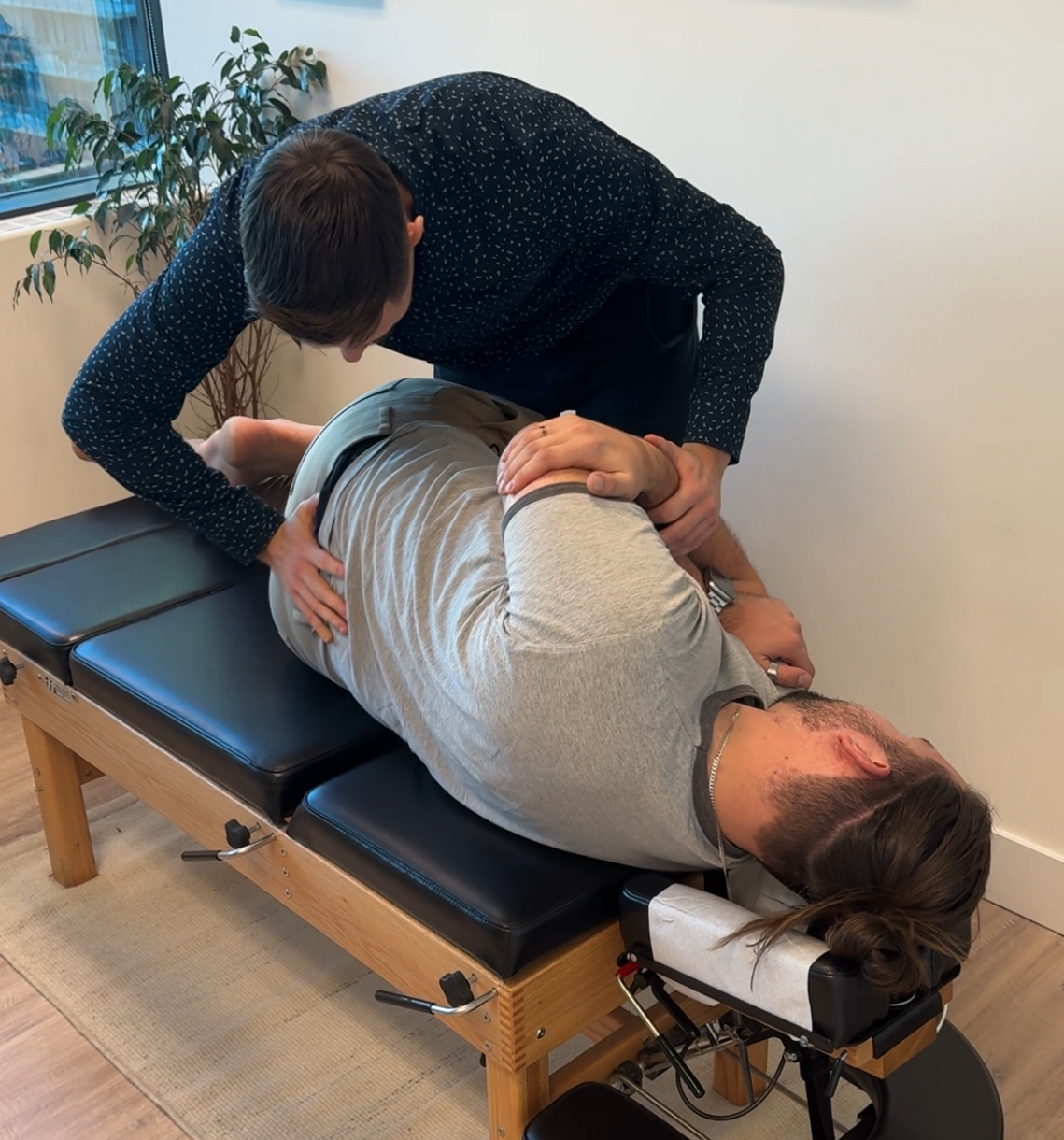
A chiropractic adjustment is a form of spinal manipulation designed to apply a controlled force to a joint.
The objective isn’t simply to “crack the back.”
The goal is to influence spinal movement and help improve the way the affected region functions.
Research supports spinal manipulation as one conservative treatment option for low back pain. A Canadian clinical practice guideline recommends spinal manipulation or spinal manipulation as part of multimodal care for chronic low back pain, alongside approaches such as exercise and education. Canadian Chiropractic Guideline Initiative guideline
A systematic review and meta-analysis of 51 trials also found moderate-quality evidence that manipulation and mobilization can reduce pain and improve function in people with chronic low back pain. Coulter et al., Spine Journal
That doesn’t mean an adjustment is the answer for every person with back pain.
It means that for the right patient, spinal manipulation can be a useful part of a conservative treatment plan.
Why Restoring Motion May Matter
When I find restricted lumbar joints during an assessment, one of my goals is to restore appropriate movement to those areas.
Why?
Because movement is an important part of normal spinal function.
An adjustment may help create a change in joint motion and may influence the surrounding neuromuscular system. This can potentially reduce the feeling of stiffness and make it easier for the person to move normally.
And this is where the treatment can become particularly interesting.
The lower back does not work in isolation.
Your lumbar spine, pelvis and hips are closely involved in activities such as walking, running, squatting, climbing stairs and getting up from a chair.
The muscles around your hips—including your gluteal muscles—play an important role in these movements.
If your back is painful or restricted, your movement strategy can change. You may unconsciously move differently to protect the painful area.
So instead of simply asking:
“How can I stretch my tight muscles?”
I often want to ask:
“Why are these muscles working this way in the first place?”
That shift in thinking is central to my NeuroStructural approach.
What About the Spinal Nerves and Glute Activation?
This is an area where precision matters.
The nerves supplying the gluteal region originate from the lumbosacral nerve roots and plexuses. However, low back pain does not automatically mean that a spinal nerve is being compressed or “pinched.”
That distinction is important.
During an assessment, I look at the whole movement system rather than assuming that every symptom has one structural cause.
If there are restrictions in the lumbar spine, altered movement patterns or neurological findings, these factors need to be considered together.
My objective is not simply to chase the location of your pain.
It is to understand why your body is moving the way it is moving and what may be contributing to your symptoms.
That is one reason why a proper chiropractic assessment is so important.
Why Chiropractic May Help When Stretching Hasn’t
Stretching can be useful.
Massage can be useful.
Physiotherapy can be useful.
Exercise can be useful.
But none of these approaches necessarily addresses every component of someone’s low back pain.
For example, if your primary problem is a restriction in spinal movement, repeatedly stretching the surrounding muscles may provide temporary relief without addressing the movement restriction itself.
This doesn’t mean that stretching is wrong.
It means the treatment should match the problem.
Current evidence supports a multimodal approach to low back pain rather than relying on one intervention alone. The Canadian guideline recommends combining appropriate manual therapy with advice, education, exercise and self-management strategies when indicated. Canadian Chiropractic Guideline Initiative
That is how I approach care as well.
An adjustment may help restore movement.
Exercise may help you build capacity.
Education may help you understand your symptoms.
Lifestyle changes may help reduce unnecessary aggravation.
Together, these strategies can create a more complete approach to recovery.
What I Look For During a Toronto Chiropractic Assessment
At Dr. Mateusz Krekora Chiropractic Clinic, I don’t want to simply ask, “Where does it hurt?”
I want to understand the bigger picture.
During an assessment, I may look at:
This helps determine whether chiropractic care is appropriate for you and whether an adjustment should be part of your treatment plan.
It also helps identify situations where further medical assessment or referral may be more appropriate.
Local Tips for Protecting Your Low Back in Toronto
Even the best treatment cannot compensate for spending 10 hours a day repeatedly stressing the same areas.
If you work downtown, consider how much time you spend sitting at a desk on Bay Street or commuting.
Try incorporating regular movement breaks throughout the day rather than remaining in one position for hours.
If you’re active on the weekends—whether cycling, running, golfing, skiing or playing hockey—build your activity gradually and give your body enough recovery time.
And don’t underestimate walking.
A simple walk through your neighbourhood or along Toronto’s waterfront can be an easy way to keep your body moving without making your recovery overly complicated.
The goal isn’t to avoid movement because your back hurts.
The goal is to find the right amount and type of movement for your current capacity.
Could Chiropractic Adjustments Be Right for Your Back Pain?
If you have been through physiotherapy, massage, stretching and exercise but your low back pain continues to return, it may be worth looking at your problem from a different perspective.
Sometimes the missing piece is not another stretch.
It may be understanding how your spine is moving—or not moving.
For appropriately selected patients, chiropractic adjustments can be a valuable component of care for low back pain. Evidence supports spinal manipulation as one conservative treatment option, particularly when combined with active strategies such as exercise and self-management. Canadian clinical practice guideline
At my Toronto chiropractic practice, my goal is to look beyond simply treating the painful area.
Through my NeuroStructural Corrective Process, I assess how your spine and movement system are functioning and develop a plan designed around your individual presentation.
You don’t have to accept recurring back pain as something you simply have to live with.
If you’re ready to understand what’s contributing to your back pain and determine whether chiropractic care may be appropriate for you, I invite you to take the first step.
Book your free 20-minute case review today and start feeling 25 again.
This article is for informational purposes only and should not be taken as medical advice. Please consult a licensed chiropractor before starting any treatment.

.png)
