September 16, 2026
You have tried physiotherapy.
You’ve had massage.
You’ve stretched your neck, strengthened your upper back and maybe even changed your pillow.
But your neck pain keeps coming back.
You may get temporary relief, only to wake up a few days later with the same stiffness, tension or aching.
At my Toronto chiropractic practice, I often see patients in exactly this situation.
They’ve tried the conventional approaches. They’ve done the exercises. They’ve received soft-tissue work. They’ve stretched their neck and shoulders.
Yet something still doesn’t feel right.
When I assess these patients, one of the things I often find is restricted movement in the joints of the cervical spine.
When certain neck joints aren’t moving well, the surrounding muscles can become protective and guarded. Over time, this may contribute to stiffness, tension and altered movement patterns.
This is where chiropractic adjustments may have a role.
Rather than simply trying to loosen a tight muscle, the goal is to identify whether restricted joint movement is contributing to the problem and, when appropriate, use a chiropractic adjustment to help restore normal movement.
For some patients, that change in movement can be an important step toward getting their neck feeling and functioning better.
The Problem: Why Does Your Neck Keep Getting Tight?
Your neck is remarkably mobile.
The cervical spine allows you to look over your shoulder, tilt your head, look up and down, rotate while driving and maintain your head over your body throughout the day.
But that mobility also means your neck is constantly responding to the demands placed on it.
Consider a typical Toronto workday.
You might spend hours looking at two computer monitors on Bay Street, then commute home while looking down at your phone, followed by an evening on your laptop or watching television.
Your neck may spend much of the day in relatively similar positions.
Then on the weekend, you might play hockey, cycle, lift weights or participate in another activity that demands much more movement.
This combination of prolonged postures, repetitive movements and sudden increases in activity can sometimes contribute to neck discomfort.
Common symptoms include:
But the location of your pain doesn’t necessarily tell us what is causing it.
That’s why assessment matters.
Expert Insight with Dr. Krekora: What Happens When the Neck Joints Become Restricted?
When I examine someone with persistent neck pain, I don’t simply look for the tightest muscle.
I assess how the different regions of the cervical spine are moving.
Sometimes I find that particular joints are significantly more restricted than others.
When a joint isn’t moving normally, the muscles surrounding that area may increase their activity as a protective response.
You may experience this as:
“My neck feels tight.”
“My shoulders are always tense.”
“I can’t turn my head properly.”
“It feels like something is stuck.”
The muscle tension is real.
But the muscle may not be the original source of the problem.
This is one reason why repeatedly stretching a tight neck doesn’t always solve the problem.
You may be stretching the muscle because it feels tight, while the underlying movement restriction remains.
Where Do Chiropractic Adjustments Fit In?
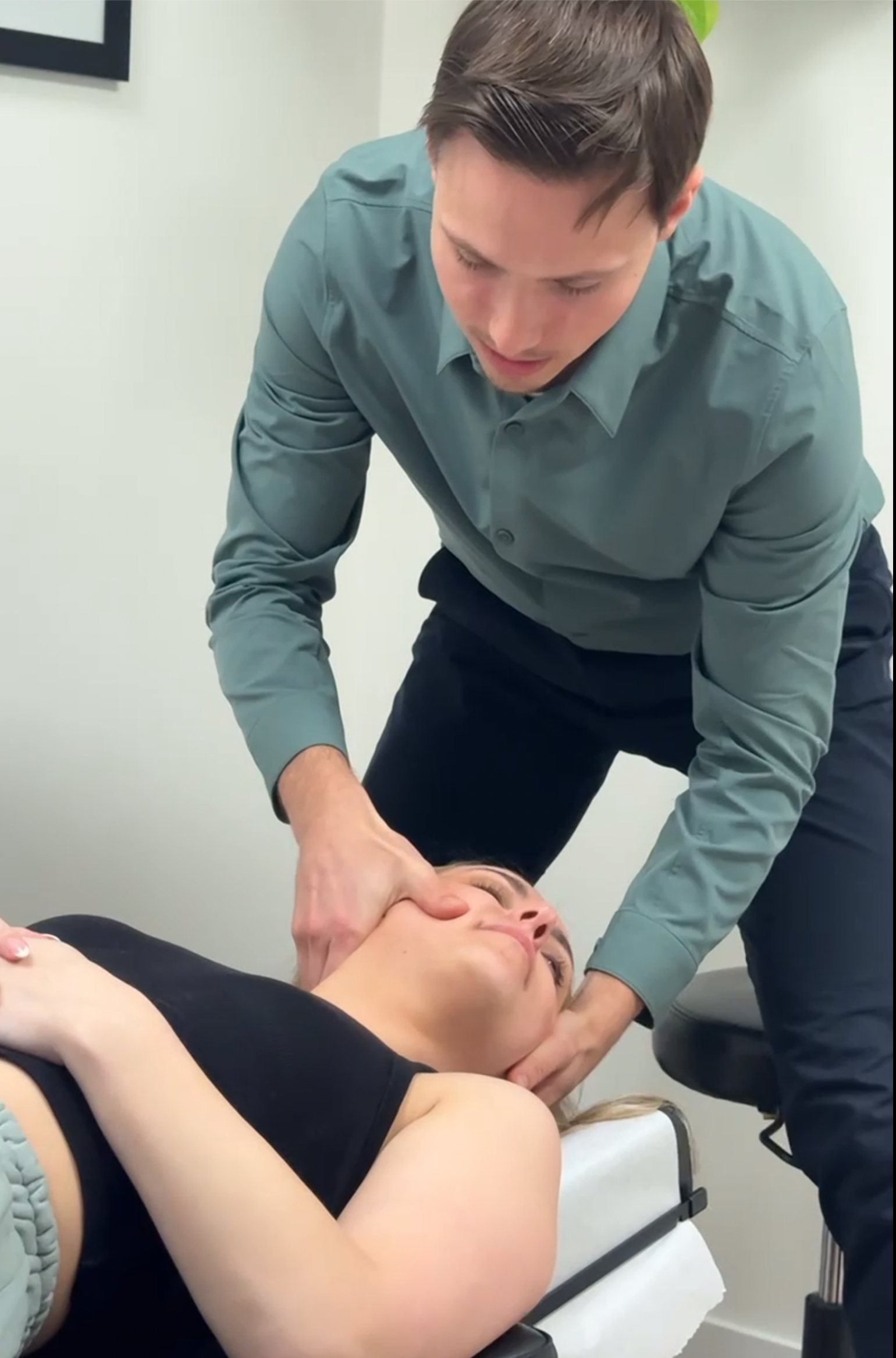
A chiropractic adjustment is a controlled manual force applied to a joint.
For the cervical spine, the purpose is to influence joint movement and function—not simply to produce a popping sound.
Evidence suggests that spinal manipulation can provide benefits for some people with neck pain, particularly when incorporated into a broader treatment plan.
A clinical practice guideline published in the Journal of Manipulative & Physiological Therapeutics recommends manipulation and mobilization as treatment options for several categories of neck pain, while emphasizing appropriate clinical assessment and individualized care. Neck Pain-Associated Disorders and Whiplash-Associated Disorders: Clinical Practice Guidelines
Research also suggests that manual therapy combined with exercise can be beneficial for people with mechanical neck pain. Cochrane Review: Exercise for mechanical neck disorders
So the question isn’t:
“Are chiropractic adjustments good for every neck problem?”
The better question is:
“Is restricted spinal movement contributing to this person’s neck pain, and would an adjustment be appropriate?”
That’s a much more individualized approach.
Why Restoring Neck Movement May Matter
The cervical spine is designed to move.
When movement becomes restricted, other parts of the neck and upper body may compensate.
Imagine turning your head to check your blind spot while driving.
If one part of your neck doesn’t rotate effectively, another area may have to contribute more movement.
Your body is remarkably good at finding ways to accomplish a task.
But repeated compensation isn’t necessarily ideal.
Over time, altered movement strategies can contribute to feelings of stiffness, fatigue or discomfort.
When appropriate, a chiropractic adjustment can be used to help restore movement to restricted spinal joints.
The objective is not to force your neck into a particular position.
It is to help the joint move more normally so that your body has the opportunity to return to a more efficient movement pattern.
Why Stretching Alone May Not Be Enough
Stretching can feel fantastic when your neck is tight.
And there is absolutely a place for mobility exercises in neck pain rehabilitation.
But consider what happens if the reason a muscle feels tight is partly related to the way your neck is moving.
You stretch the muscle.
It loosens temporarily.
Then you go back to work.
A few hours later, the tension returns.
This can become a frustrating cycle:
Restricted movement → protective muscle activity → stiffness → stretching → temporary relief → restricted movement remains.
This is why I rarely see neck problems resolving by simply stretching the tightest muscle.
Instead, I want to understand the relationship between:
The treatment should address the individual—not just the symptom.
What About “Nerve Pressure” in the Neck?
This is an important distinction.
Neck pain does not automatically mean that a nerve is being compressed.
Some people have local mechanical neck pain without neurological involvement.
Others may experience symptoms that extend into the shoulder, arm or hand and may require a more detailed neurological assessment.
If you have symptoms such as significant weakness, progressive numbness, loss of coordination or other concerning neurological changes, you should be appropriately assessed rather than assuming that an adjustment is the answer.
At my clinic, this is why I don’t simply adjust someone’s neck because they say, “My neck hurts.”
I first want to determine whether chiropractic care is appropriate.
The NeuroStructural Approach to Neck Pain
At Dr. Mateusz Krekora Chiropractic Clinic, my approach is based on looking beyond the location of your pain.
I call this the NeuroStructural Corrective Process.
The goal is to understand how your spine is functioning and how restrictions, movement patterns and muscular responses may be contributing to your symptoms.
For someone with persistent neck pain, this may involve assessing:
From there, chiropractic adjustments may be incorporated when clinically appropriate.
But adjustments are only one piece of the puzzle.
Long-term improvement may also require strengthening, mobility work, ergonomic changes, education and changes to the activities that are repeatedly aggravating your neck.
Your Toronto Lifestyle Can Affect Your Neck
Living in Toronto often means spending a significant amount of time sitting, commuting and working at a computer.
If you’re working downtown, try not to spend an entire workday in the same position.
Change positions regularly.
Take short movement breaks.
Move your shoulders and upper back.
Adjust your workstation so your screen is positioned comfortably in front of you rather than constantly looking downward.
If you spend your weekends being active, avoid going from a sedentary workweek directly into an intense workout without an appropriate warm-up and gradual progression.
And remember: your neck was designed to move.
The goal isn’t to keep it perfectly still.
The goal is to keep it moving well and build the capacity to handle the demands you place on it.
Could Chiropractic Adjustments Be Right for Your Neck Pain?
If you’ve already tried massage, stretching and physiotherapy but your neck pain continues to return, it may be time to look at the problem from a different perspective.
Instead of asking only:
“How can I loosen my tight neck muscles?”
Consider asking:
“Why does my neck keep becoming tight in the first place?”
For some people, restricted cervical joint movement may be an important part of the picture.
When appropriate, chiropractic adjustments can help restore movement to restricted spinal joints and may be a useful component of a broader treatment plan for neck pain. Current evidence supports manual therapy, including manipulation and mobilization, for certain types of neck pain, particularly when appropriately combined with active care. Clinical Practice Guidelines for Neck Pain
At my Toronto chiropractic practice, I aim to identify the factors that may be contributing to your symptoms rather than simply chasing pain from one appointment to the next.
Your goal shouldn’t be to spend the rest of your life managing a stiff, painful neck.
You should be able to work, exercise, drive, sleep and enjoy your life without constantly thinking about your neck.
Feel strong. Live to the fullest.
If you’re ready to find out what’s contributing to your neck pain and whether chiropractic care may be appropriate for you, I invite you to take the first step.
Book your free 20-minute case review today and start feeling 25 again.
This article is for informational purposes only and should not be taken as medical advice. Please consult a licensed chiropractor before starting any treatment.

.png)
